Hestaria · Guides
Knee osteoarthritis
Knee arthritis and strength training: what actually helps
If your knee aches on the stairs and a doctor has said "arthritis", the most useful thing you can do is often the thing that feels least intuitive: make the muscles around it stronger. The question isn't whether to train. It's how.
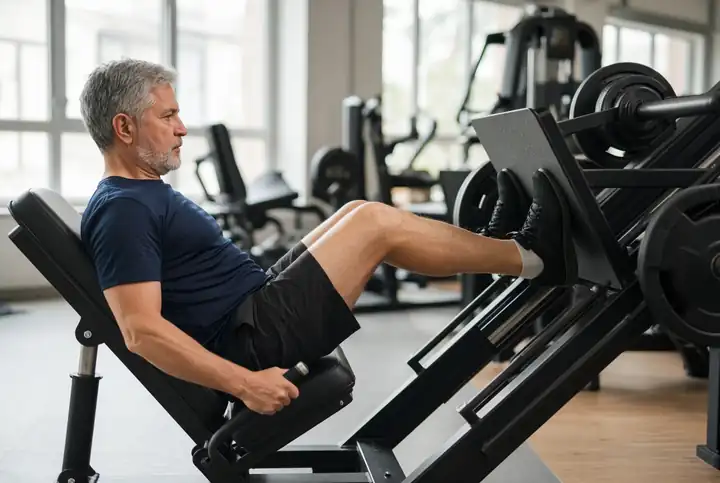
Why strength work helps an arthritic knee
Exercise is recommended as a core, first-line treatment for knee osteoarthritis in international guidelines — for everyone with the condition, not as a last resort. Stronger thigh and hip muscles take load off the joint and steady it, and for most people that means less pain and easier stairs within a couple of months.
What changes with arthritis isn't whether you load the knee. It's the range you work through, how quickly you add weight, and how you read the pain.
Which exercises, and which to go easy on
| Usually comfortable | Often aggravating early on |
|---|---|
| Leg press, stopping before the knee bends further than is comfortable | Deep barbell squats |
| Box squat to a bench at a height you choose | Walking lunges and split squats |
| Low step-ups, controlled on the way down | Jumping and running on hard ground |
| Sit-to-stand from a chair | Kneeling on the affected knee |
| Hip thrusts and bridges, calf raises, cycling | Leg extensions at heavy loads through full range |
None of the right-hand column is forbidden forever. Many people get back to squatting deeply once the muscles are stronger. It's a question of order.
How to read the pain
Some ache is expected, and it isn't a sign of damage. A simple rule that physiotherapists use works well:
- During the session: discomfort up to about 5 out of 10 is acceptable if it settles when you stop.
- The next morning: the knee should be no worse than it was before the session. If it's clearly worse — two points or more on the same 0–10 scale — the dose was too high. Go back to the previous week's weight.
- Sharp pain, locking, giving way, or a hot swollen knee are not training pain. Stop and get it looked at.
How weight should go up
More slowly than the muscles would like. The knee is the limit, not the thigh. Add weight in small steps — 2.5 to 5 lb on lower-body exercises rather than the usual 5 to 10 — and only when every set reaches the top of its rep range and the next morning was fine.
What a first session can look like
| Exercise | Week 1 |
|---|---|
| Leg press, comfortable range | 2 × 10–12, light |
| Lat pulldown | 2 × 8–12 |
| Hip thrust or glute bridge | 2 × 10–12 |
| Chest press | 2 × 10–12 |
| Calf raise | 2 × 12–15 |
Two sets, stopping well short of failure, for the first two weeks. The aim is to find starting weights and learn the movements — not to feel exhausted.
What Hestaria changes when you tell it about your knee
- Squats become leg press or box squats; lunges become step-ups; split squats come out.
- Calf raises are added, and lower-body weight goes up in smaller steps.
- It asks you to rate the knee before sessions and applies the next-morning rule for you.
- Every change is shown with the reason, and the whole plan prints for your doctor or physio to adjust.
When to see someone first
- A knee that locks, gives way, or swells suddenly.
- Pain at night or at rest that is getting worse.
- A recent injury, or surgery in the last year.
- A replaced knee — follow your surgeon's limits on range and impact.
Further reading
- OARSI guidelines for the non-surgical management of knee, hip and polyarticular osteoarthritis (2019).
- NICE guideline NG226: Osteoarthritis in over 16s — diagnosis and management (2022).
A plan built around this, that your doctor can check
Hestaria builds a strength program around your conditions and medications — including this one — and prints it for your doctor to mark up. Whatever they change, the plan follows.
Get early accessThis page is general information about exercise, not medical advice. It is not a substitute for your own doctor or physiotherapist, who know your history. If anything here conflicts with what they have told you, follow them.