Hestaria · Guides
Osteoporosis and osteopenia
Osteoporosis and deadlifts: an honest answer
Men get osteoporosis too — often found late, after a fracture or on a scan for something else. If you've been told your bones are thin, the right response is more strength training, not less. The part to be careful with is how your spine bends under load.
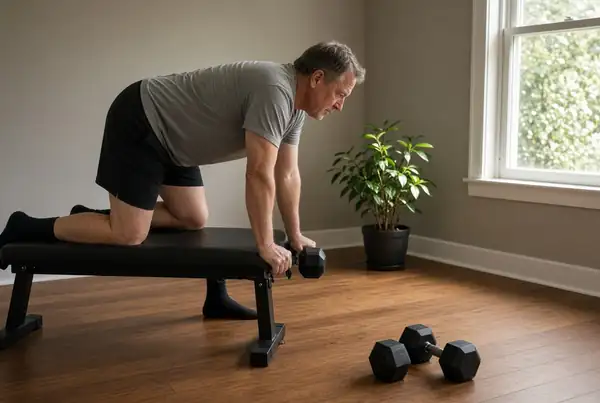
Why lifting is good for thin bones
Bone responds to load. Muscle pulling on bone and weight going through the skeleton are the signals that maintain it, which is why resistance and impact exercise are recommended for people with osteoporosis. Just as importantly, strength and balance training reduce falls — and it's the fall, far more often than the lift, that turns thin bone into a fracture.
What to be careful with
The spine's vertebrae are the bones most at risk, and they're most vulnerable when the back is rounded forward under load or twisted with weight in your hands. So the caution isn't about heavy weights as such. It's about position:
- Sit-ups, crunches and toe-touches — repeated, loaded forward bending.
- Lifting from the floor with a rounded back.
- Twisting movements with a weight in your hands.
- Sudden, jerky movements at the end of your range.
So — deadlifts?
The honest answer is that it depends, and on you rather than the exercise. A well-coached hip hinge with a flat back loads the hips and legs, not the bending spine, and some people with low bone density do train it under supervision. But it's a skill, and the cost of getting it wrong is high. For most people starting out on their own, we'd leave it until later.
So Hestaria asks. With osteopenia, or osteoporosis without a spine fracture, the program keeps a hinge — a light kettlebell deadlift, learned with a flat back and loaded slowly, ideally with a coach or physiotherapist to start. With a previous spine fracture or high fracture risk, or if you're not sure, the hinge waits: the hip thrust trains the same muscles with the spine supported on a bench, and the program asks for your doctor's or physiotherapist's review before loaded work involving the spine.
Balance matters as much as strength
Preventing the fall matters more than the density number. Two minutes of balance work in every session is enough to make a difference:
- Weeks 1–4: heel-to-toe standing and single-leg standing with both hands resting on a counter.
- Weeks 5–8: fingertips only.
- Weeks 9–12: hands hovering just above the counter. Never fully away from support when you're on your own.
What a session can look like
| Exercise | Why |
|---|---|
| Leg press or goblet squat | Load through the hips and legs |
| Hip thrust | The hinge muscles, spine supported |
| Chest-supported row or lat pulldown | Upper back strength and posture, back supported |
| Incline or landmine press | Pushing without loading the spine overhead |
| Bird dog or Pallof press | Trunk strength without bending the spine |
| Heel-to-toe and single-leg stands, calf raises | Balance and fall prevention |
Over time the loads on machines and the leg press can become genuinely heavy — that is good for bone — as long as your back stays neutral.
What Hestaria changes when you tell it about your bones
- It asks about spine fractures and fracture risk. Lower risk keeps a light, coached hinge; higher risk swaps it for the hip thrust and asks for a clinician's review first.
- Balance work is added to every session and progressed as above.
- No weight increases in a week with a fall, a near-fall, or new back pain.
- The plan prints for your doctor or physio to mark up — including putting an exercise back.
If you've had a vertebral fracture, or sudden back pain after a minor strain, have a physiotherapist review your program before you start.
Further reading
- Royal Osteoporosis Society. Strong, Steady and Straight: an expert consensus statement on physical activity and exercise for osteoporosis (2019).
- Bone Health & Osteoporosis Foundation (US): exercise guidance for people with osteoporosis.
A plan built around this, that your doctor can check
Hestaria builds a strength program around your conditions and medications — including this one — and prints it for your doctor to mark up. Whatever they change, the plan follows.
Get early accessThis page is general information about exercise, not medical advice. It is not a substitute for your own doctor or physiotherapist, who know your history. If anything here conflicts with what they have told you, follow them.